'Irish immigrant Florence Burke has lived in Massachusetts for more than a decade but he's still a tenant farmer and his family lives in near-poverty. He came to America for a better life, but finds his adoptive country less than hospitable. Florence recognizes that owning land is the path to prosperity, but the bank won’t grant him a loan and he’s running out of options.
An opportunity arises that could make his dreams come true, but it involves great personal risk to both himself and his family. He recalls the gamble he took when he fled the Great Hunger in Ireland, and wonders if he could make a gamble on his life one more time? Will his wife and children understand his decision to join the war?'..
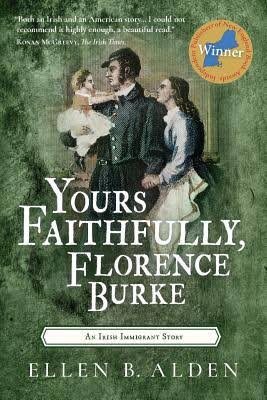
Florence Burke’s story is also part of the wider history of the famine in Ireland. During the Great Famine of 1845–1852, starvation, poverty, disease and the loss of livelihoods forced hundreds of thousands of Irish people to leave their homeland. Many travelled to the United States, where Irish immigrants established new communities and began new lives far from Ireland.
Reviews from Goodreads.com :
'Best book that I have read in a very long time. Author made me feel that I was there and wrote with descriptive writing that brought me to that time in history. I could not wait to finish the book and find out what happened and see the story unfold. A must read'
'Great characters, vivid descriptions, and totally believable. Wonderful story based on letters found in an attic. Highly recommended.'
'I had not read a book that focused on the Irish immigration to Massachusetts. It was well written and very interesting.'
'Wonderful story based on a box of found letters sent by a Civil War Soldier to his wife. This book is set in West Springfield, MA and tells of the struggles of a young family who emigrated from Ireland.'

Florence Burke in Union Army Uniform
For Florence Burke, leaving Ireland meant becoming part of the enormous movement of Irish immigration to America that transformed both countries during the nineteenth century. Irish immigrants arrived in American cities and towns looking for employment and opportunities, while also bringing with them memories of the country they had left behind. For many families, emigration was not simply a journey to a new country but a response to difficult circumstances in Ireland.
Personal letters such as those connected with Florence Burke provide an unusually intimate glimpse into the experience of Irish emigration. Historical accounts can tell us how many people left Ireland, but letters reveal something different: the personal hopes, fears and connections that accompanied the journey. They help bring the story of Irish emigrants to life and show how closely families in America remained connected to relatives and events in Ireland.
'It is five years since Ellen Alden found a small mahogany box in the attic of her home in West Springfield, Massachusetts. The box contained 19 original letters written by her great-great-grandfather Florence Burke to his wife, who is also called Ellen. They bear extraordinary testimony to an Irish immigrant’s involvement in the American Civil War.'

Ellen Alden, author of Yours Faithfully, Florence Burke
The story of Florence Burke is one small part of a much larger history. The Great Famine changed Ireland permanently, with mass emigration becoming one of its most lasting consequences. The Irish men and women who left for America, Canada, Britain and Australia carried their memories of Ireland with them, creating communities overseas that continue to have strong connections with Ireland today.
'At the outbreak of the civil war in 1861, there were 1.6 million Irish-born living in the United States. Of those, 180,000 joined the Union Army and 20,000 the Confederates.
The civil war was bloody beyond the imaginings of any of its combatants. Damian Shiels, the foremost Irish historian of the war, estimates that between 25,000 and 35,000 Irishmen were killed in it.'

Dáithí and Maura of RTE's Today Show